
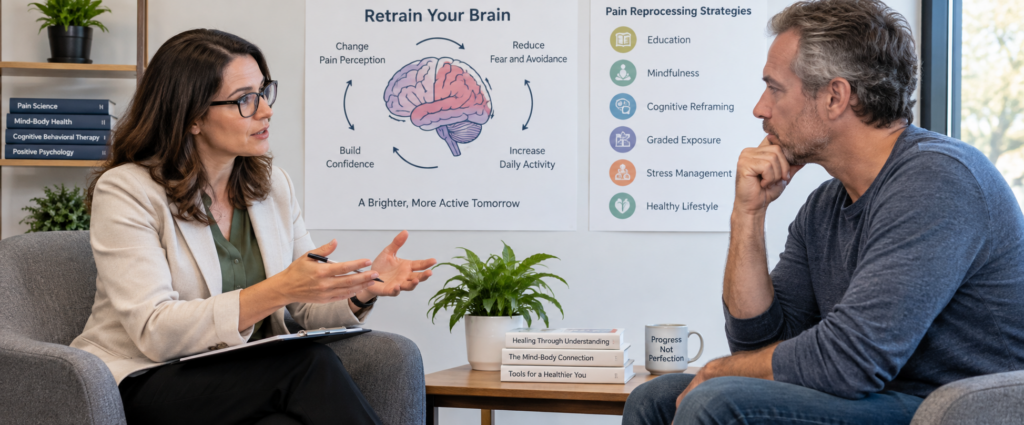
Chronic widespread pain can affect many parts of the body at once, making everyday activities, exercise, sleep, and work more difficult. While conventional pain management may include medication, physical therapy, and lifestyle changes, researchers are also investigating treatments that focus on how the brain and nervous system process pain.
One approach receiving renewed attention in 2026 is Pain Reprocessing Therapy (PRT). A new pilot randomized clinical trial published in the Journal of Psychosomatic Research evaluated PRT in adults with chronic widespread pain and found that the approach was feasible and acceptable, with favorable trends across several pain, functional, psychological, and quality-of-life measures. The researchers emphasized that the findings are preliminary and should be followed by larger controlled trials. Read the published study on PubMed.
What Is Pain Reprocessing Therapy?
Pain Reprocessing Therapy is a psychological treatment designed to change how a person understands and responds to persistent pain. Instead of viewing every pain sensation as proof that the body is being damaged, PRT teaches patients to consider whether some sensations may be generated or amplified by changes in the nervous system’s processing of danger signals.
This approach is particularly relevant to nociplastic pain, a type of pain associated with altered pain processing rather than clearly identifiable ongoing tissue damage. Nociplastic pain can be difficult to manage because conventional approaches aimed only at an injured structure may not address all of the factors maintaining symptoms.
PRT incorporates elements of psychological therapies, pain education, mindfulness, cognitive behavioral approaches, and exposure-based techniques. The goal is not to tell someone that their pain is imaginary. Instead, the therapy attempts to change the perceived threat associated with pain sensations and reduce fear and avoidance.
This concept complements some of the mind-body strategies discussed in our article on mindfulness practices for pain.

Why the Brain Matters in Chronic Pain
Pain is a protective experience involving much more than a signal traveling from an injured body part to the brain. The nervous system continuously evaluates sensory information and determines how much attention and protection a sensation may require.
When pain persists, the nervous system can become more sensitive. Experiences such as fear, stress, poor sleep, and repeated avoidance of movement may interact with pain processing and influence how symptoms are experienced.
This does not mean that chronic pain is “all in your head.” Pain is real, even when scans or examinations do not reveal an obvious ongoing injury. The goal of modern pain science is to understand the biological, psychological, and behavioral factors that can contribute to persistent symptoms.
A review published in 2026 describes PRT as an approach intended to interrupt the pain-fear-pain cycle by changing the interpretation and perceived threat of pain sensations. PubMed’s review of Pain Reprocessing Therapy provides additional background on the approach.
What the New 2026 Trial Found
The new randomized pilot trial is particularly interesting because it examined PRT in adults with chronic widespread pain rather than focusing only on chronic low back pain.
The researchers screened 416 people and enrolled 53 participants. Twenty-seven participants received PRT, while 26 received a psychoeducation control intervention. The PRT group received an initial health evaluation and education session followed by eight weekly individual one-hour PRT sessions.
The study primarily examined whether PRT could be delivered successfully and accepted by participants. The researchers also examined changes in pain intensity, pain interference, anxiety, depression, fear of movement, fatigue, myalgia, self-efficacy, and quality of life.
Participants assigned to PRT attended an average of 7.8 sessions. The study reported favorable trends across all measured secondary outcomes at 12 weeks. However, the study was small, and the researchers described the results as preliminary rather than definitive evidence of effectiveness.
How PRT May Change the Pain Response
PRT is based partly on the idea that the brain can learn to interpret certain pain sensations as threatening even when there is no longer an immediate physical danger requiring protection.
During therapy, patients may learn to observe sensations with less fear and gradually approach movements or activities that they have been avoiding. This process can help challenge the assumption that pain necessarily means additional damage is occurring.
For example, someone with persistent back pain may avoid bending because they believe the movement will injure their spine. Under appropriate professional guidance, PRT may help that person examine the sensation, reduce catastrophic interpretations, and gradually regain confidence in safe movement.
The process is individualized. Pain can have many causes, and PRT should not be used to dismiss symptoms that require medical investigation.
PRT and the Fear-Avoidance Cycle
Fear of pain can sometimes lead people to avoid activities. Avoidance may provide short-term reassurance, but prolonged inactivity can contribute to reduced physical capacity, loss of confidence, and increased concern about movement.
This can create a cycle:
- Pain creates fear or concern about movement.
- Fear encourages avoidance of certain activities.
- Avoidance can reduce physical confidence and conditioning.
- Reduced confidence may increase attention to bodily sensations.
- Increased fear and attention can make returning to activity more difficult.
PRT attempts to address this cycle by helping patients reinterpret pain sensations and gradually develop a greater sense of safety around movement.
This does not mean that people should push through severe or unexplained pain. Safe activity levels should be determined according to the underlying condition and appropriate medical guidance.
How PRT Differs From Traditional Pain Management
Traditional pain management often focuses on reducing symptoms and improving physical function. Depending on the diagnosis, treatment may include medication, exercise, physical therapy, injections, surgery, or other interventions.
PRT takes a different emphasis by directly addressing the relationship between pain sensations, perceived danger, beliefs, emotions, and behavior.
It can therefore fit within a broader multidisciplinary approach rather than necessarily replacing other treatments. A person may work with a physician, physical therapist, and mental health professional while also using exercise, sleep improvement, and other strategies.
Pain Defeat already provides educational information about ways to manage pain without medication, which can provide useful context for understanding a broader approach to pain care.
What Earlier Research Says About PRT
The 2026 chronic widespread pain study builds on earlier research involving chronic back pain. A randomized clinical trial published in JAMA Psychiatry compared PRT with placebo and usual care in adults with primary chronic low back pain.
That earlier trial reported substantially greater improvement in pain among participants receiving PRT and investigated changes in brain activity associated with pain processing. A later follow-up examined whether improvements could persist over a longer period. The original randomized trial is available through PubMed.
Importantly, results from chronic low back pain cannot automatically be applied to every chronic pain condition. Chronic widespread pain, neuropathic pain, inflammatory pain, and pain caused by structural problems can involve different mechanisms.
Could PRT Work Alongside Exercise?
Movement is an important part of many chronic pain management programs. However, people who associate movement with danger may struggle to stay active.
A treatment approach that reduces fear of movement may therefore complement physical rehabilitation. Rather than viewing psychological and physical treatment as competing approaches, clinicians may combine them according to the individual’s needs.
Our guide on posture and chronic pain also discusses the importance of movement, physical habits, and rehabilitation in managing persistent discomfort.
The important distinction is that exercise should be appropriately selected and progressed. PRT does not mean ignoring physical limitations or continuing an activity that could cause injury.
PRT May Also Be Available Through Telehealth
Another interesting development is the exploration of group-format and remote delivery. A 2026 pilot study evaluated group PRT delivered through telehealth to veterans with chronic back and neck pain.
The researchers reported high feasibility and acceptability. The study also found greater improvements in pain among later cohorts after the treatment protocol was modified based on participant feedback. Because the study did not include a control group and involved a relatively small sample, the authors recommended caution when interpreting the clinical results. See the 2026 telehealth PRT study on PubMed.
Remote delivery could eventually make certain forms of pain-focused psychological treatment easier to access, particularly for people who have difficulty traveling to specialty clinics.
Who Might Consider Pain Reprocessing Therapy?
PRT may be worth discussing with a qualified healthcare professional when persistent pain appears to involve significant fear, avoidance, or altered pain processing. It may be especially relevant to people whose evaluation has not identified an ongoing injury that fully explains the severity or persistence of their symptoms.
However, suitability should be determined individually. Before beginning a pain reprocessing program, a healthcare professional should consider whether symptoms have been appropriately evaluated and whether other medical conditions need treatment.
A 2026 paper in Current Pain and Headache Reports proposed a framework for assessing readiness for PRT, including cognitive and behavioral readiness, provider alignment, and system-level factors. The proposed PRT readiness framework is available on PubMed.
What PRT Does Not Mean
Because the therapy focuses on the brain’s interpretation of pain, it is important to avoid several misconceptions.
- PRT does not mean pain is imaginary. Pain is a real sensory experience.
- PRT does not mean every pain condition is psychological. Structural, inflammatory, neurological, and other medical causes remain important.
- PRT is not a guaranteed cure. Research is still developing.
- PRT does not replace medical evaluation. New, worsening, or unexplained symptoms should be assessed appropriately.
- PRT does not mean ignoring warning signs. A treatment program should account for the individual’s medical history and diagnosis.

How to Discuss PRT With a Healthcare Provider
If you are interested in pain reprocessing therapy, start by discussing your symptoms and treatment history with a healthcare professional. Ask whether your pain pattern could involve nociplastic or centrally mediated pain and whether a pain-focused psychological intervention might complement your current treatment.
You can also ask what type of professional provides PRT, how the program is structured, whether individual or group sessions are available, and how progress will be measured.
Keeping track of pain levels, activities, sleep, and functional goals may also help you and your healthcare team evaluate changes over time. Pain management is often more useful when the focus extends beyond a single pain score to include mobility, daily function, sleep, mood, and quality of life.
The Future of Pain Reprocessing Research
The recent research suggests that PRT is becoming an increasingly important area of investigation within chronic pain care. The new chronic widespread pain trial provides preliminary evidence that the approach can be delivered and accepted by patients, while other 2026 research is exploring group and telehealth formats.
Researchers are also studying the neurological mechanisms that may explain why some people respond to PRT. A 2026 study investigated whether changes in gray matter following PRT were associated with clinical improvement in chronic back pain, adding to research examining how treatment may influence pain-related brain processes. See the neuroimaging research on PubMed.
The next step is larger, well-controlled trials that can determine which patients benefit most, how long improvements last, and how PRT compares with or complements other evidence-based treatments.
Final Thoughts
Pain Reprocessing Therapy represents a different way of thinking about chronic pain. Rather than focusing exclusively on eliminating a physical source of discomfort, it examines how the nervous system interprets pain and how fear, beliefs, and avoidance may contribute to persistent symptoms.
The September 2026 randomized pilot trial in chronic widespread pain adds encouraging preliminary evidence, but it is not enough to establish PRT as a universal treatment. Larger studies are still needed.
For people living with chronic pain, the broader lesson is that effective care may require more than one strategy. Medical evaluation, physical rehabilitation, healthy sleep, appropriate activity, stress management, and evidence-based psychological approaches can all have a place in an individualized treatment plan.
If persistent pain is affecting your daily life, speak with a qualified healthcare professional about the causes of your symptoms and which treatment options may be appropriate for you.